
You could try to access your school account to download work but then struggle to log in. You may have had your personal information compromised or there could be issues with your school’s e-learning software. All of this can result from a cyber-attack.
Schools and students use the internet for numerous things. Online tuition can occur, work can be uploaded and information can both be shared and saved electronically. Although technology can aid students’ learning, it can also introduce fresh security concerns.
Cyber-attacks are now a key issue for schools in 2026. Hackers attempt to gain access to school accounts, e-learning software and both school and student information.
However, what constitutes a cyber-attack? Why are schools a popular hacking target? And what can students do to safeguard themselves?
Within this guide, I will discuss cyber-attacks, together with the most prevalent forms of these attacks. Furthermore, I will explore the impact that they can have on both students and schools and provide basic advice on how to keep secure whilst using the internet.
What is a Cyber Attack?
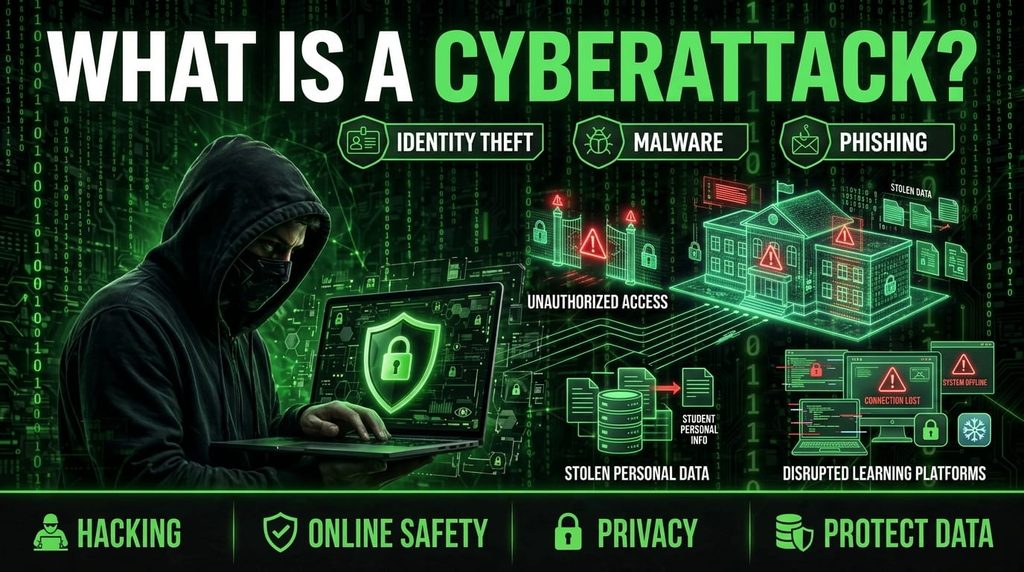
A cyber-attack is where unauthorised people try to view, modify, take or manage data or systems.
There are a variety of techniques which cyber-criminals can utilise to attack sites, computers, phones and online profiles. Common aims for those committing cyber attacks can be to extract sensitive data, extort money or disrupt digital services.
A student could for example, be sent an email which appears to be from their school. Within the email they are requested to click on a link and type in their password. Following this, the student will be directed to a fraudulent site. The cyber criminal could then acquire the students details.
This is a form of ‘phishing’ attack.
Anyone can be impacted by, and even organisations such as businesses, hospitals, schools, colleges and universities. Schools in particular are key targets as they hold extensive data both relating to and about students.
Why are schools and children targeted?
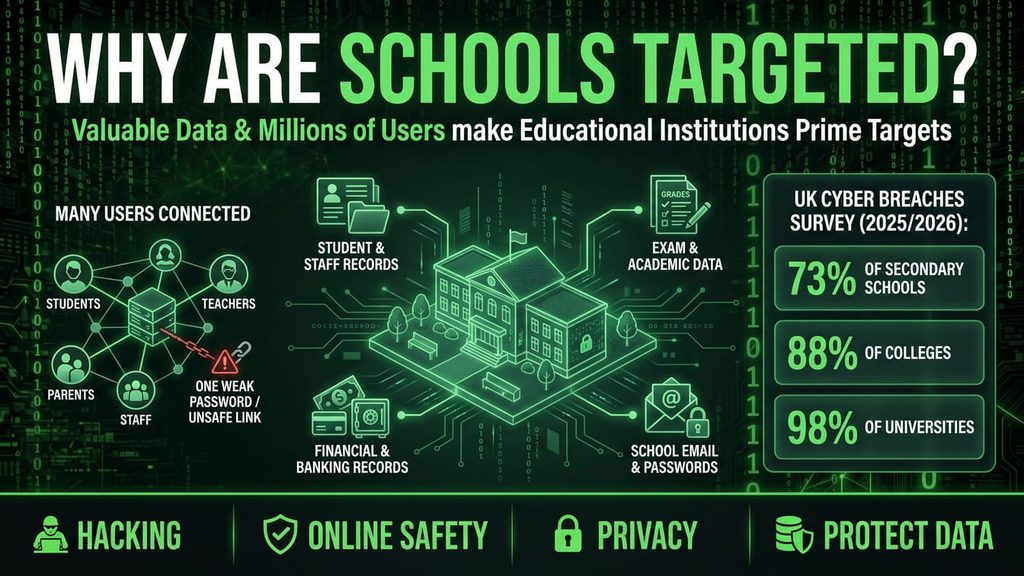
Children and staff both utilize technology within schools. Children will often use online learning, along with a school website and email. Staff and students also use apps.
Technology can then be used to hold data such as:
- Children’s names and contact details.
- School emails and passwords.
- Children’s and staff marks and exam results.
- Work and school documents.
- Staff details.
- School finance and business data.
Such data can be exploited, and/or even sold. Cyber criminals can also use this data to launch additional cyber-attacks.
Furthermore, there are numerous people who use a school’s technology. Students, staff and even parents can all access devices and software. Poor password protection or dubious web links can therefore cause issues.
The UK government’s ‘Cyber Security Breaches Survey’ (2025/26) found that 73% of secondary schools, 88% of further education colleges and 98% of higher education establishments had encountered some sort of breach or cyber-attack within the last 12 months.
Common forms of cyber attacks
Cyber attacks can be both at an individual level or on the school network.
Below are 6 common types of cyber attack.
1- Phishing
Scammers will often create emails and/or texts which are designed to persuade individuals to give away their personal information.
For example, a student may receive a text informing them that,
“Your school account will be blocked. Click here to verify your password.”
Although this appears genuine, it may in fact be linked to a fake site and students may then be requested to enter their password.
Scammers can then gain entry to students’ accounts.
2- Ransomware
This is a form of malicious software which prevents people from accessing data or systems and then asks for payment to allow re-access.
For example, schools can become unable to access data relating to students, tests and/or business matters.
School life and education can therefore be affected.
In some cases, individuals will even access data and then may use this as leverage to ask for payment by threatening to release it.
3- Malware
Malware is software which is used to cause damage.
This can be distributed by untrusted sites, virus ridden email and/or sites.
A student could download a free programme from a site. Unwillingly, malware is then installed onto their device.
Malware can be used to obtain, observe and/or destroy data.
4- Passwords
Criminals can attempt to either obtain or steal people’s passwords.
They can do this using obtained passwords, brute force and fraudulent sites.
Students can also place more than one account (for example, a school, email and social media account) at risk by using the same password for these.
5- Denial of Service
People can launch denial of Service Attacks which overload websites and/or web based services.
This may cause a service to become either sluggish or even non-operational.
A student may then be unable to log on to a school website or an on-line exam system.
6- Artificial Intelligence enabled cybercrime
Alongside other technology, artificial intelligence is also affecting cybercrime.
Using AI, people are able to generate realistic emails, chat and voice recordings. These can often appear more human and include less errors.
For instance, a student might be sent an email which seems to have been sent by a member of teaching staff and which urgently requests money or personal details.
Students should always investigate any unexpected requests prior to replying.
How is my student life being impacted by cyber crime?
Alongside affecting computer systems, cyber crime can also impact on a student’s educational and personal lives.
Below are some impacts that can occur:
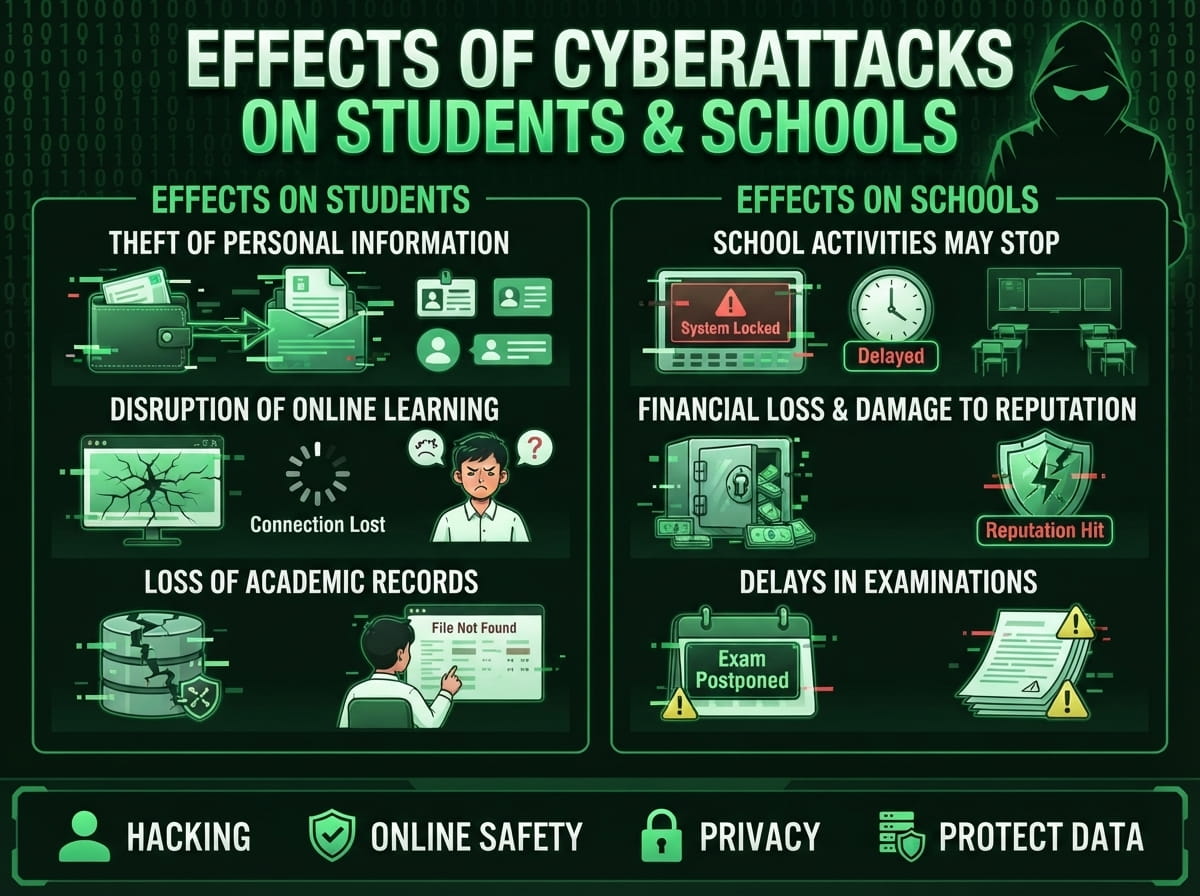
1- Personal information theft
Students often enter personal information onto online school and education sites.
Attackers could then gain someone’s name, email address, and/or other personal data.
Such data can then be used for fraudulent activity, such as setting up false profiles and/or committing personalised fraud.
2- Online Learning
Students often utilise online resources to support their learning, alongside completing work and revision.
A student may be unable to access online learning if it is affected by a cyber incident.
This could then affect a student’s ability to download learning resources and/or to upload work, in time for deadlines.
3- Loss of Student Data
Student data is highly valuable. This can include exam results, attendance and work along with qualifications.
Such data can be lost, stolen or altered without permission as a result of a cyber incident.
Students and staff can both experience stress whilst attempting to restore student data.
4- Online fraud
Fraudsters can send out false information such as scholarship, course and payment notifications.
A student could be sent a fraudulent scholarship notification which then requests a registration charge.
The fraudster may then vanish after the student has transferred funds.
Prior to sending money or personal data, students should verify information on the authentic school/college website.
5- Anxiety and Distrust
Students can feel anxious upon discovering that their information has been compromised or that their account has been hacked.
They may also lose confidence when accessing school and e-learning sites.
Parents can also suffer from distrust in relation to digital educational provision.
How are schools being impacted by cyber-attacks?
Schools can also suffer as a result of a cyber-attack.
1- Disruption
Attacks can cause disruption to a school’s attendance registers, e-learning tools, website and school management systems.
Staff can then have difficulty accessing teaching resources and/or pupil information. School members can also experience disrupted workflows.
2- Monetary Impact
Schools may require expert assistance in order to repair, and in some cases re-establish, their systems. They may also have to pay for legal advice, data and systems re-establishment, and for new systems.
3- School Reputation
Parents are aware that schools should safeguard data.
If a school does not secure their computer systems then parents may come to doubt the schools’ capability in securing data.
4- Delays in Examinations and Assignments
Online exam, learning and submission systems are also vulnerable to cyber-attacks.
In 2026, there was a cyber-attack on the Canvas system. Many organisations were impacted and student information was also compromised. Again this illustrates how a cyber-security issue can impact on students’ learning.
How To Stay Safe Online
Students do not require specialist knowledge to enhance their online security. There are also several straightforward ways to increase one’s levels of safety.
1- Good Passwords
Ensure that your passwords are not easily identifiable.
Do not include your name and/or date of birth and avoid basic numerical sequences.
Also, make sure that passwords differ for key accounts. Password managers are a reliable way of keeping track of your passwords.
2- Two-factor authentication
This is an extra form of authentication which may be used in addition to a password.
After typing in your password, you may then be asked to type in a code as further confirmation.
This means that even if someone has obtained your password, they will still struggle to gain access.
3- Don’t open questionable links
Don’t click on links within email, text and social media messages.
Before submitting personal information, ensure you are confident about who sent you the message and the URL of the relevant website.
If a communication seems time sensitive, always confirm its authenticity by contacting a recognised member of staff at the school.
4- Update devices
It is important that you update your phone, computer, browser and apps.
This can often plug ‘holes’ that hackers may be able to exploit.
5- Use reliable websites and apps
Only download apps through recognised app stores or from reliable sites.
Don’t download unrecognised and/or untrustworthy software or free apps.
6- Safeguard data
Never divulge your password, exam information, student number or personal information to untrusted individuals.
Consider carefully what personal information you choose to share on social media.
How to prevent cyber-attacks
Whilst students can look after their own data, it is also a school’s duty to ensure that its data is safe.
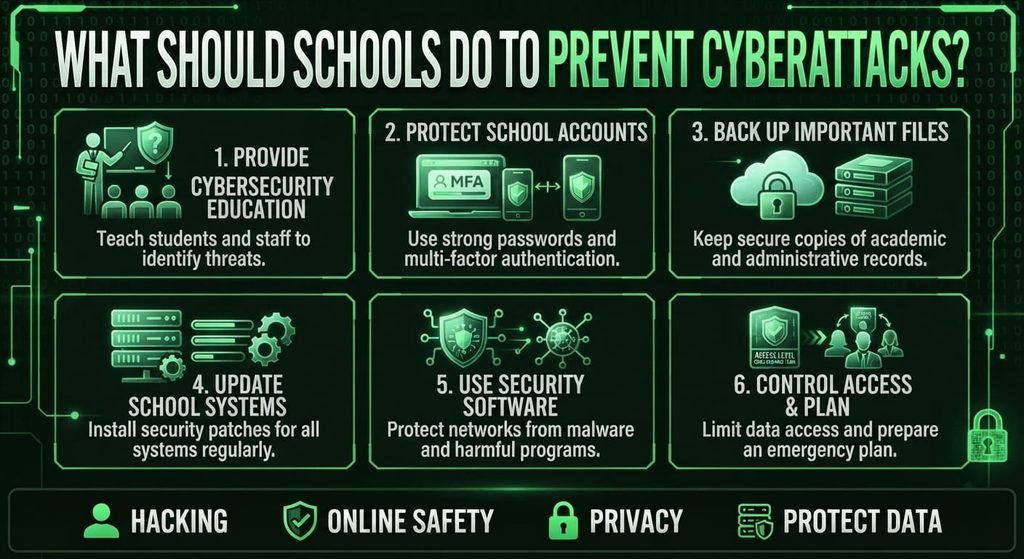
There are various key steps a school can implement:
- Provide cybersecurity education: Teach staff and students to recognize fraudulent information and sites.
- Protect school accounts: Ensure that staff and students use good quality passwords and two factor authentication.
- Back up important files: Maintain secure back-up data for both educational and business data.
- Update school systems: Continually update school computer/software systems.
- Use security software: Implement software to secure school computers and networks.
- Control access: limit staff and student access to relevant information.
- Prepare an emergency plan: Establish a strategy for dealing with a cyber-incident which impacts upon school computer/software systems.
Furthermore, schools should assess the security of external educational websites and programmers prior to allowing staff and students to utilize them.
Conclusion
Individuals and educational institutions are currently becoming increasingly concerned about cyber safety. People can suffer information loss and both students and schools can experience negative impacts on education and on school data storage. Money can also be affected.
With an increasing digitalisation of schools, children should be educated on how to stay safe on the internet.
Students should be able to recognise unsafe messages and protect themselves and their online presence. Schools must also enhance their cyber security provisions and prepare for potential cyber problems.
Whilst it is commonly believed that only members of the IT field are responsible for cyber safety, in fact everyone including students, staff, teachers and parents has a role within guaranteeing good cyber safety.